Summary
Audio uses your browser's built-in voice support.
Marine researcher Johanne is sent to investigate a series of unusual incidents at a salmon farming facility located deep within a Norwegian fjord. The area has recently suffered unexplained problems: fish are behaving strangely, underwater equipment has been damaged, and local workers report unusual disturbances coming from the depths. Although many dismiss the incidents as technical faults or natural causes, Johanne suspects there is something unusual occurring beneath the water.
While examining the fjord, Johanne learns about old local stories describing a monstrous creature that once inhabited the area — the Kraken. According to legend, the creature was not simply a myth but an ancient predator that lived far below the surface, rarely interacting with humans. The stories suggest the creature was feared by generations of fishermen, who believed it could drag entire ships beneath the waves.
The situation escalates when two teenagers disappear after being out near the water. Their deaths cannot be explained by normal marine predators, and the scale of the damage suggests something far larger is responsible. Johanne begins comparing the evidence from the attacks with the strange activity recorded at the salmon farm and starts to believe that the creature from the legends may actually exist.
Further investigation reveals that expansion of the fish farming operation and human interference in the fjord may have disturbed the Kraken’s habitat. Noise, construction, and underwater equipment have affected an area of the seabed that had remained untouched for centuries. Rather than being a mindless monster, the creature appears to be reacting aggressively after being forced into contact with humans.
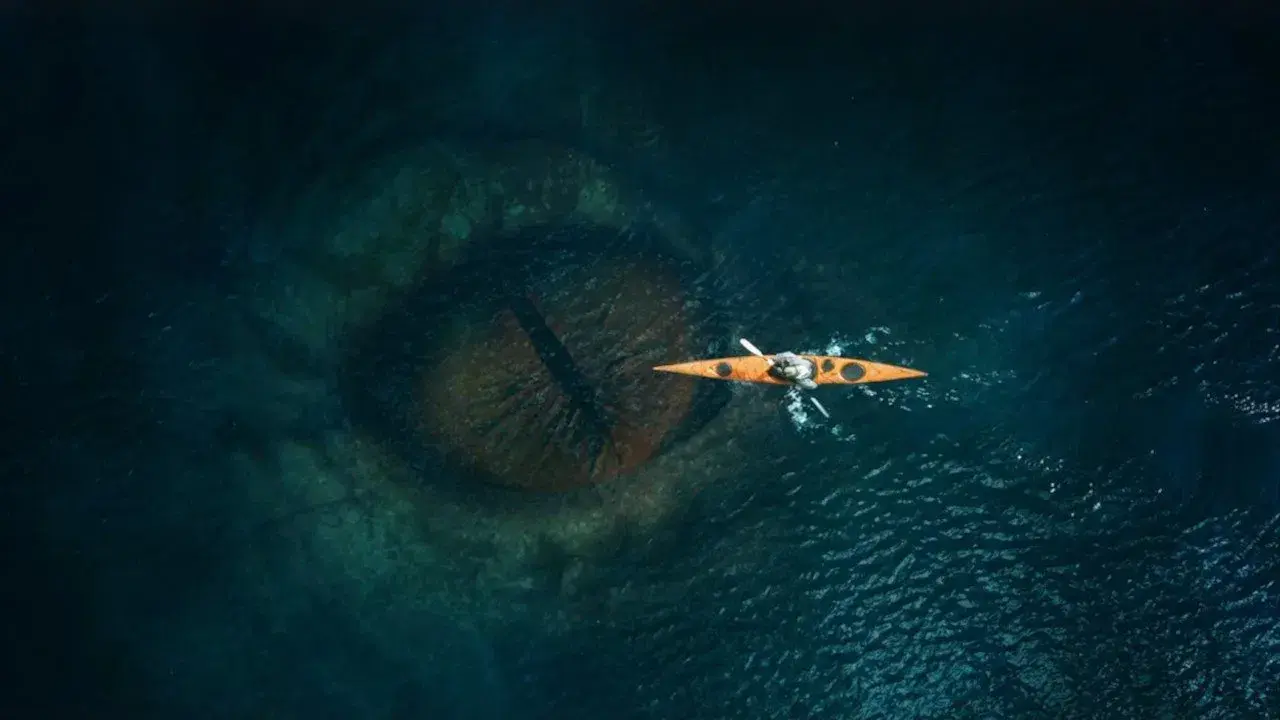
As attacks increase, panic spreads through the community. Boats are destroyed, people disappear, and attempts to locate the creature reveal its enormous size and intelligence. The Kraken is shown to be a powerful deep-sea animal capable of hiding in the darkness, attacking without warning, and using its tentacles to overwhelm anything on the surface.
Johanne tries to convince officials that conventional responses will not work, but many initially refuse to believe that a legendary creature is responsible. As more evidence emerges, the authorities organise an attempt to track and stop the creature before it reaches more populated waters.
The final confrontation occurs in the fjord as Johanne and others attempt to lure the Kraken away and prevent further destruction. They discover that the creature is not acting out of simple aggression but as a defensive response to humans invading its territory. The battle becomes not only a fight for survival but a question of whether humanity has the right to destroy something ancient simply because it has become inconvenient.
Johanne places a sonic boom in the water but she is grabbed by the monster and falls out of the boat. When the Kraken pulls her under the water she is face to face with it and sees something in its eyes. When the sonic boom explodes, the Kraken loosens its grip of Johanne. The blast successfully kills the Kraken.
Erik, Maria and Henriette paddle to meet Olav who has pulled Johanne from the water and Erik cuddles her crying.
One year later, we see Maria in her boat that she has named Johanne placing a rose into the water and thinking about Johanne saying that only 5% of the world's waters have been explored and that it is probably better that way as humans are left with a greater understanding of the hidden world beneath the ocean and the consequences of disrupting environments that humans do not fully understand. The legend of the Kraken is revealed to have been based on truth all along — a creature that had remained hidden for generations until mankind awakened it.
As we go under the water again, deep below the surface to an underwater trench, we see an enormous, translucent egg. Inside the glowing membrane is a massive shadow slowly wriggly creature that looks like a smaller version of the Kraken, implying that the Kraken was protecting its offspring all along.
Source: Wikipedia (CC BY-SA 3.0)